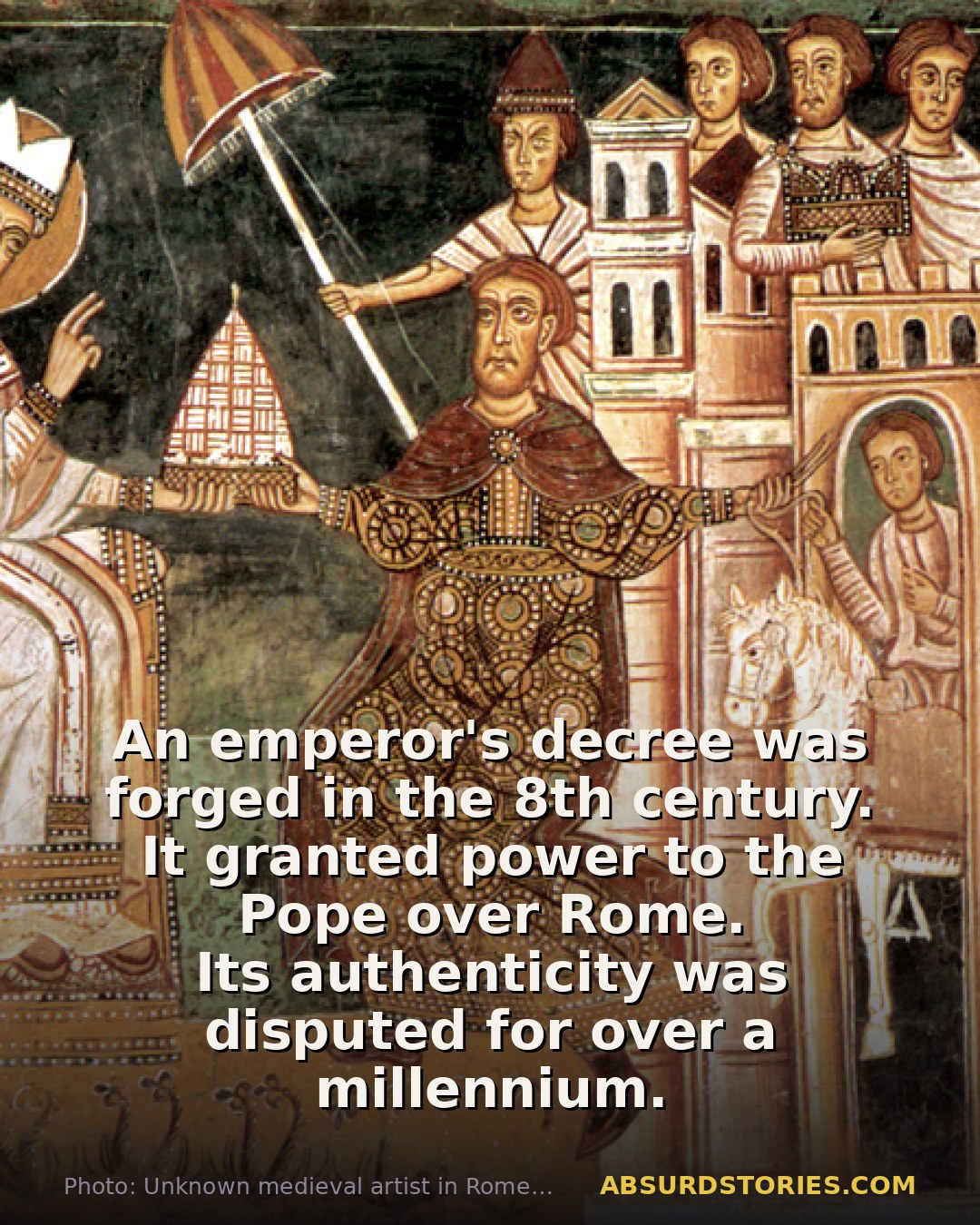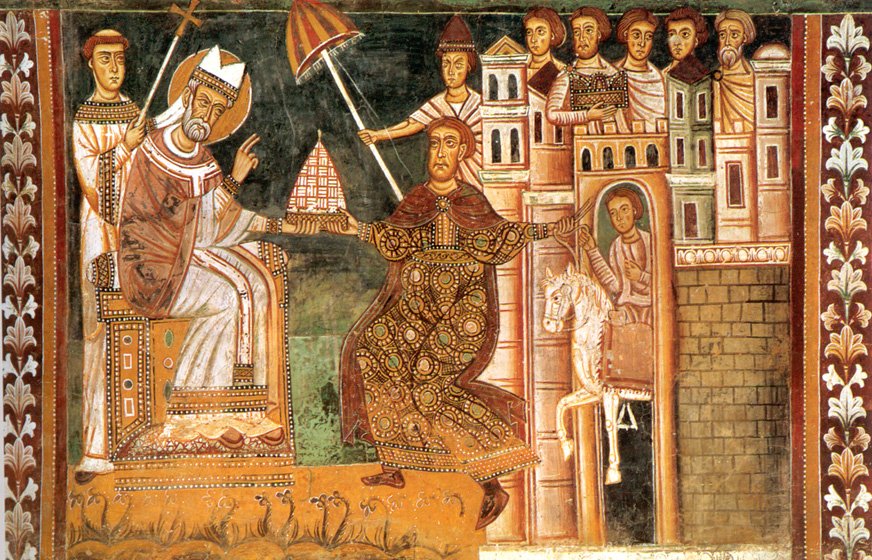
The Donation of Constantine is a forged decree attributed to the 4th-century emperor Constantine the Great. This document supposedly transferred authority over Rome and the western Roman Empire to the Pope. It was likely composed in the 8th century and used in the 13th century to support papal claims of political power.
Several existing manuscripts of the document carry the title Constitutum domini Constantini imperatoris. It was included in the 9th-century collection known as the Pseudo-Isidorean decretals. The authenticity of the document was first challenged by Lorenzo Valla, a Renaissance humanist, in the 15th century, although debates about its legitimacy had begun much earlier.
The decree inaccurately referenced the co-consul of Constantine, indicating the forger's lack of historical knowledge. The document claimed that Constantine professed Christianity and granted Pope Sylvester I various privileges, including control over Rome and the surrounding territories. It also told a story of Sylvester curing Constantine’s leprosy and rescuing Rome from a dragon.
In a significant move, the document proposed that Constantine bestowed supreme authority upon the Pope, asserting his control over other principal sees, including Alexandria and Jerusalem. It inaccurately suggested that the Pope had elevated authority over the church and could reclaim power over the imperial city.
Some historians believe an early draft of the Donation was created to assist Pope Stephen II during negotiations with Pepin the Short. In return for political support, Pepin provided lands that would later form the basis of the Papal States. This could have motivated the creation of the document as a political tool.
Another theory posits that it was crafted to bolster the position of the Lateran in the face of the growing prominence of the Vatican. This suggests a complex interplay of ecclesiastical power rather than a straightforward deception aimed at Constantinople.
Evidence of the Donation's influence is found in its references throughout medieval history. It was invoked during conflicts between the papacy and secular powers. Despite its eventual discrediting, it played a significant role in shaping the political landscape of the time.
The Donation of Constantine stands as a remarkable example of how a forged document can affect power dynamics and historical narratives for centuries.